Product Master Summary
What Is Product Master Summary?
Product Master Summary tells you information about specific products from nutrient composition to ratings and which markets this will be available in. This section is important for keeping track of product information, ingredient information, substitutions, pricings, menu configuration for a product, order guides, any alternative names, crediting, unit conversions, attributes and the actual process of creating this product.
Navigate To Product Master Summary
Click on ERP on the main navigation menu and hover on Vendor.
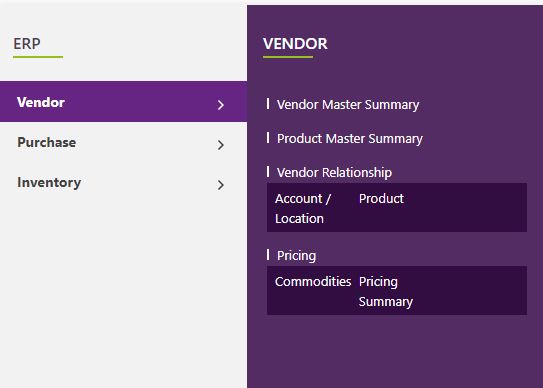
A new screen appears which shows the list of all of the core vendor tables. Locate the one which says Product Master Summary and click on it.
This will open up a screen where you can see all the active and inactive Product Master Summaries that are available for your company.
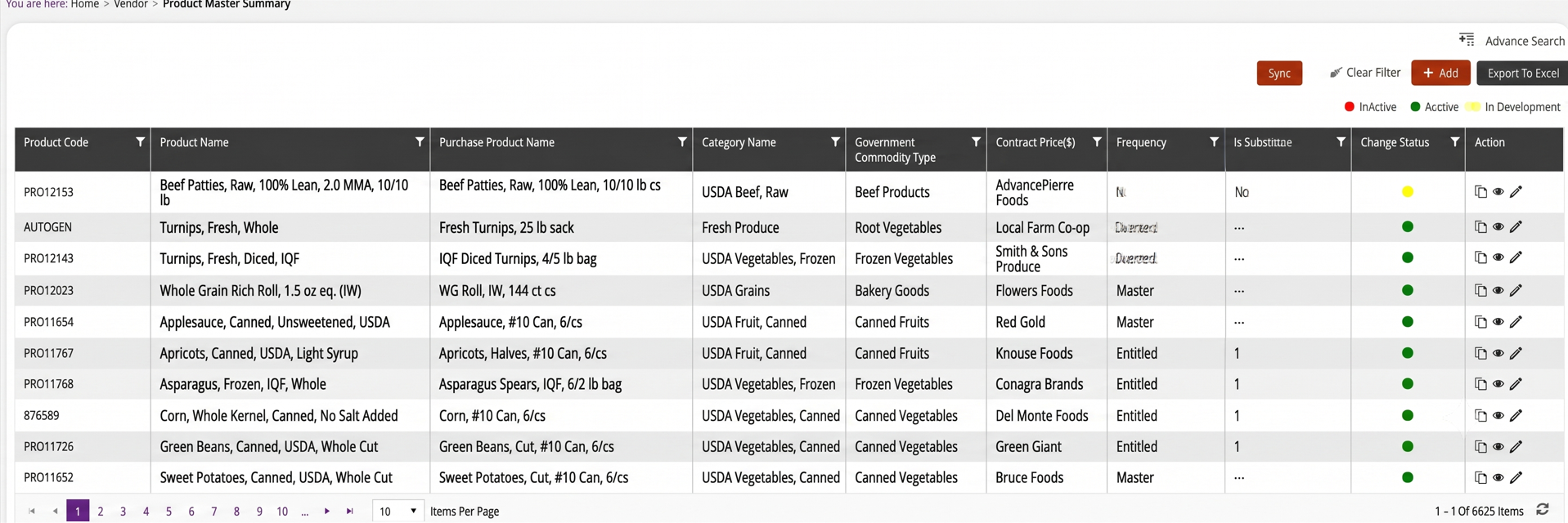
Product Master Summary Status Colors
The status color indicator on the Product Master Summary screen shows the current state of each product at a glance.
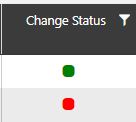
Red - InActive
Green - Active
Yellow - In Development
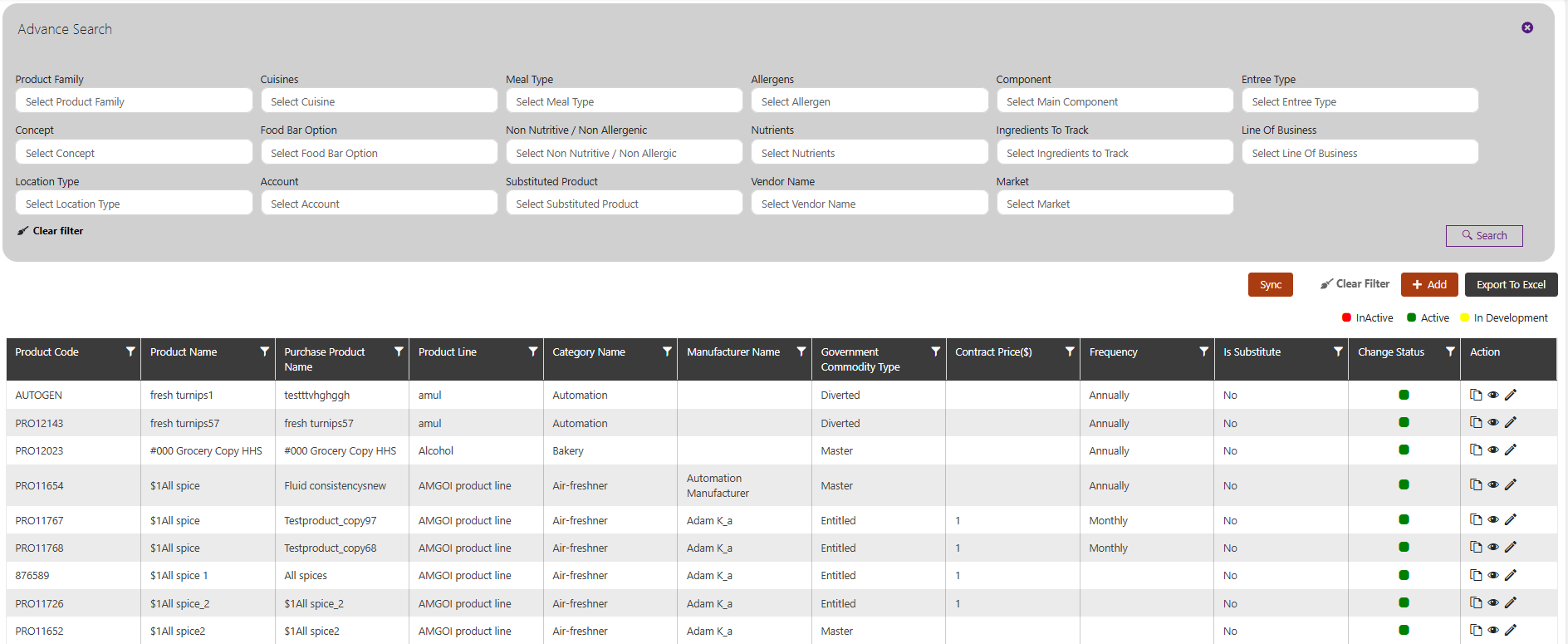
Product Master Summary Advance Search
Use the Advance Search to filter the products displayed on the Product Master screen based on the criteria applied.
Sync Button
After clicking on this button, a toast message will appear on screen saying: Sync Process Starts. It will take Max 2 Minutes. This button will sync the product master across all accounts of a customer.
Product Master: Action Column
On the Product Master Summary screen, the Action column provides three options for each product row:

- Copy icon: Copies all content of the respective product and starts the Add Product workflow pre-filled with that data.
- View icon: Displays all available information of the respective product in read-only mode.
- Edit icon: Displays all available information of the respective product in Edit mode.
Add New Product
Click the Add button on the top right side of the screen.
The system will open a popup screen in which you can fill in the following fields (Note: Mandatory fields are indicated by the * next to the name):
Primary
Primary
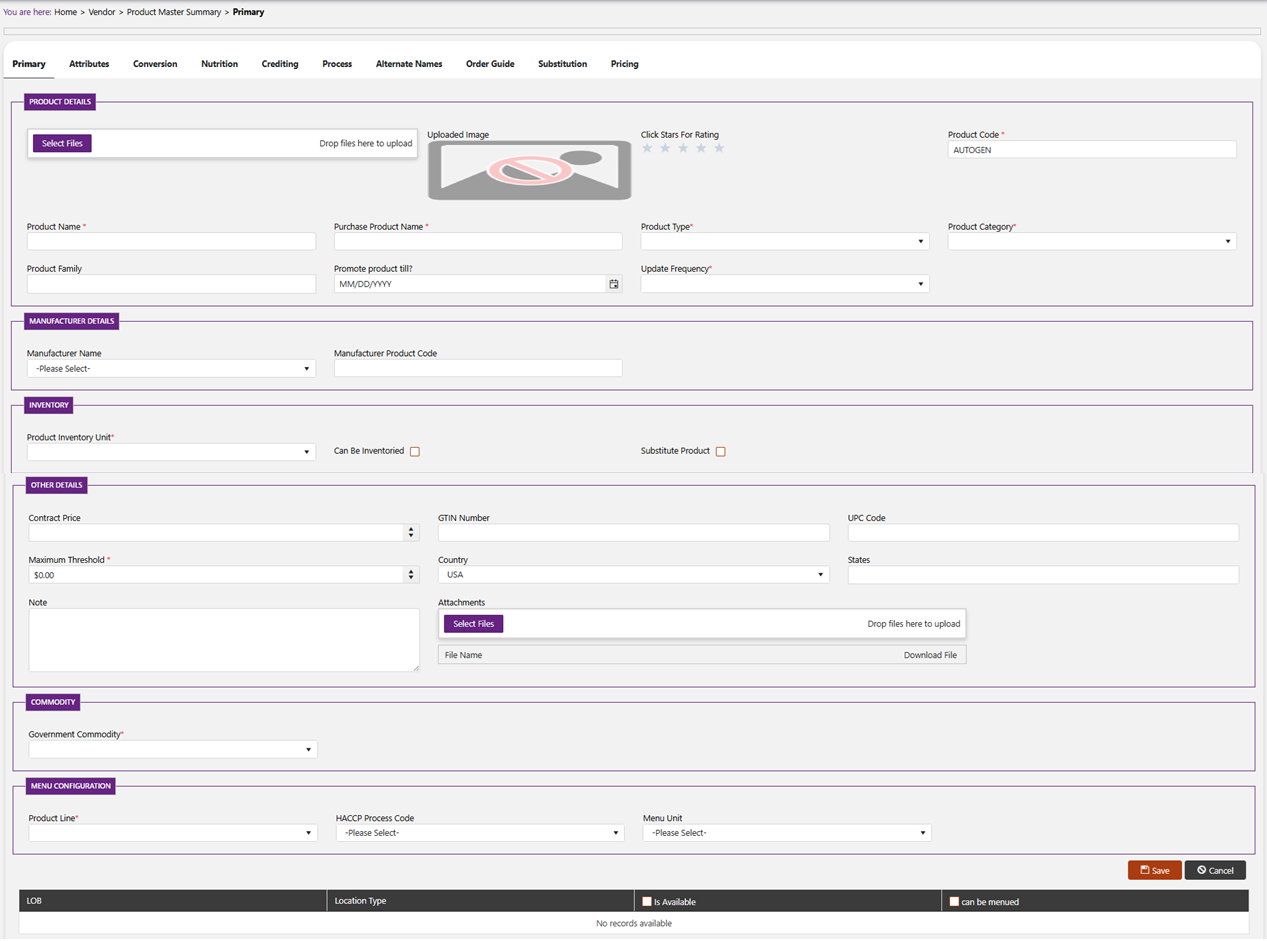
Rating: You can rate this product out of 5 stars.
Product Code: This is automatically generated by the system.
Product Name: Please enter the name of this product.
Purchase Product Name: If your product has a different name at the time of purchase, then write the name you want customers to see.
Product Type: Select the Product Type from the dropdown list.
Product Category: Select the Product Category from the dropdown list.
Product Family: Click inside the textbox to choose from the Product Family list generated.
Promote Product till?: Enter a date if this product is a limited time offer.
Upload Image: Click the gray box with the green outline to upload an image of this product.
Manufacturer Name: Include the Manufacturer Name from the list generated.
Manufacturer Product Code: Write in the code the manufacturer uses for this product.
Product Inventory Unit: Select the product's unit from the list provided.
Can Be Inventoried: Check the box if the product can be inventoried.
Substitute Product: Check the box if this is a substitute product.
Contract Price: Click in the box to enter a number.
GTIN Number: Enter the GTIN Number (this is an identifying number for this product on the label).
UPC Code: Enter the UPC Code (this is another identifying number for this product on the label).
Maximum Threshold: Enter the maximum threshold for a dollar amount of this product.
Note: Add any notes for this product.
Attachments: Click upload to add any files for this product.
Country: Choose the country.
States: Click in the box to see the states and choose the ones that this product is available for.
Product Line: Choose the Product Line. This will generate the table with all the LOBs with this Product Line. You will then click "Is available" if it is an available option for this LOB or "Can be Menued" if this product can be offered on the menu.
NoteBased on the Product Line selection under the Menu Configuration section, the LOB & Location Type will be displayed, which can be further enabled or disabled for Is Available and Can Be Menued options.
Is Available: If checked, the respective product will be available for all locations under the respective location type.
Can Be Menued: If checked, the respective product can be made available for the menu. :::
Government Commodity: Click to see a list of options if this is a Government Commodity. If it is not, then click "No".
Attributes
Attributes
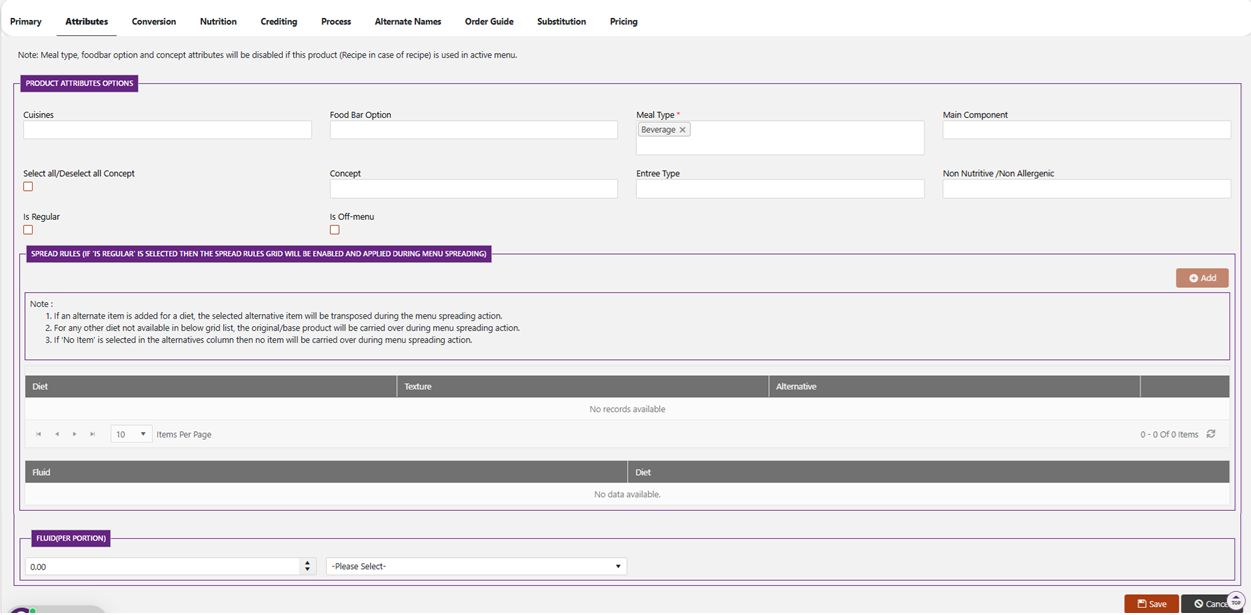
- Cuisines: Click the box to add Cuisines here.
- Meal Type: Click the box to add Meal Types here. (Mandatory — multi-select required)
- Main Component: Click the box to add the Main Component here.
- Non Nutritive/ Non Allergenic: Click the box to add any allergens or non allergen identifiers here.
- Food Bar Option: Click to add any food bars here.
- Concept: Click the box to add any Concepts here. Click the Select all/Deselect all to either select all the concepts or clear all concepts from this attribute.
- Entrée Type: Click the box to add an entrée type.
Spread Rules
Under the Attributes tab, the Spread Rules section allows you to define diet and texture alternatives for this product.
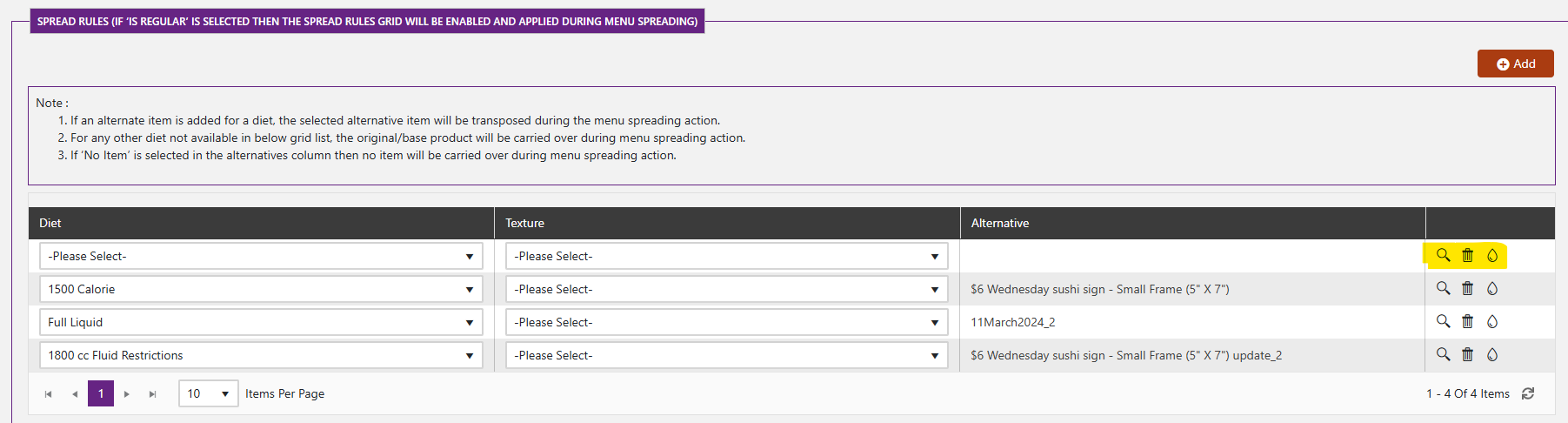
Click the Add button under the Spread Rules section.
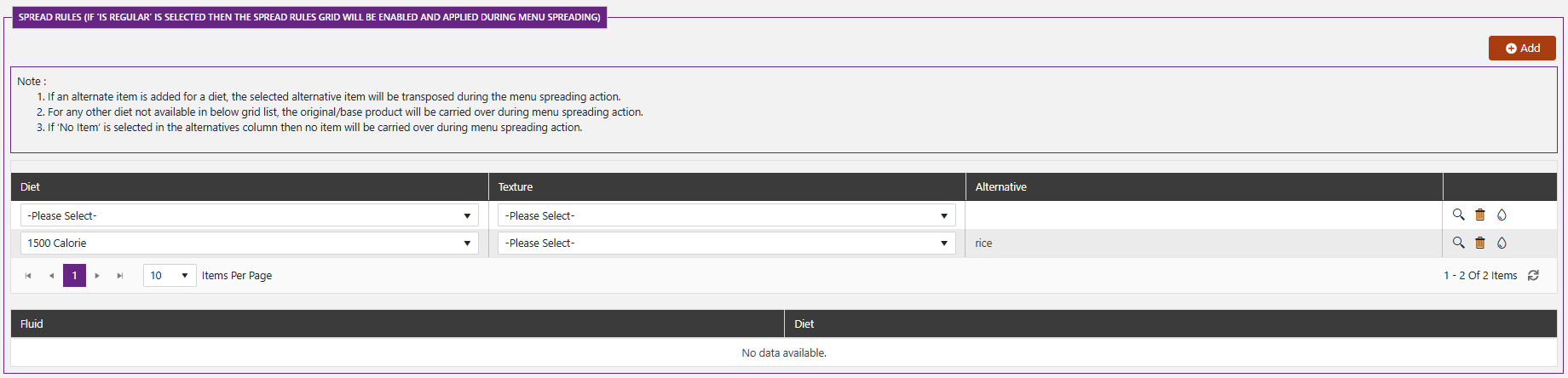
- A new row is added to the Spread Rules grid.
Select a Diet (dropdown) and a Texture (dropdown) for the row. Then click the search icon next to the Alternative column to open the product/recipe selection popup.
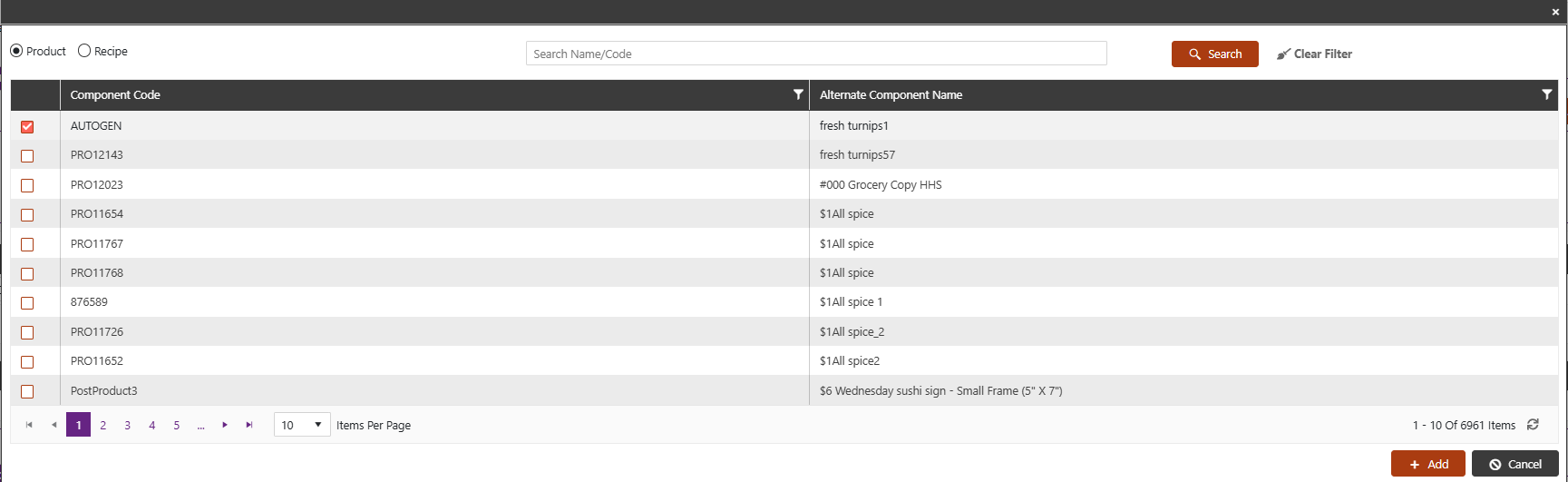
Select one or more products or recipes and click Add. The selected items will appear under the Alternative column.

- Use the Delete icon to remove a specific Spread Rule row.
Fluid Consistency
The Fluid Consistency icon in the Spread Rules section allows you to specify fluid consistency alternatives.

Clicking the Fluid Consistency icon expands an additional section below the Spread Rules grid.
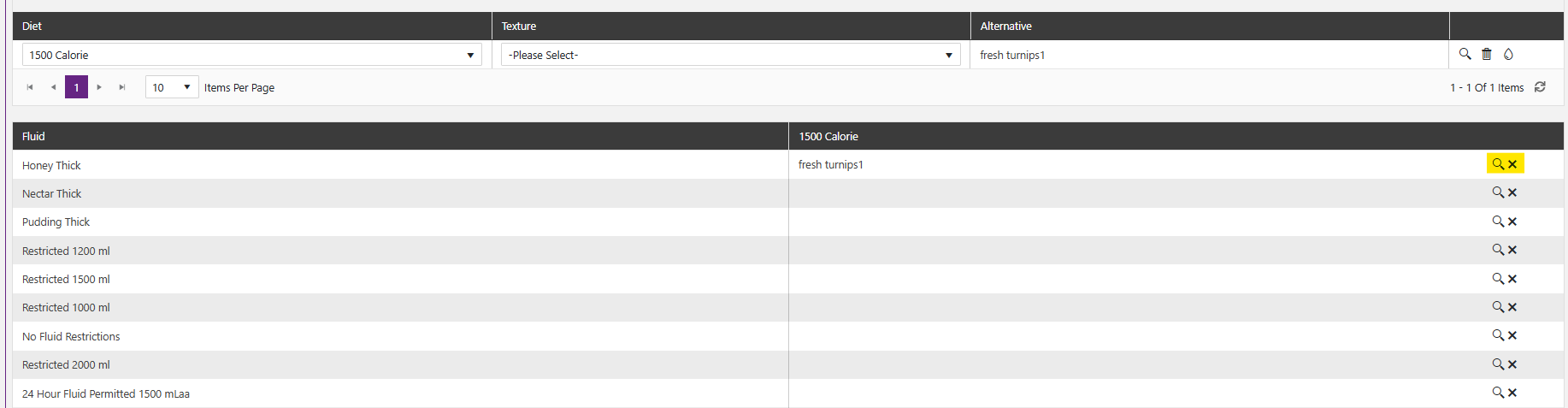

Click the search icon in this section to open the same product/recipe selection popup. Select one or more products or recipes and they will be added to the Fluid Consistency section.
Conversion
This screen handles Unit of Measure (UOM) Conversions for a specific food product, ensuring that the system can accurately translate quantities between ordering, inventory tracking, and recipe preparation.
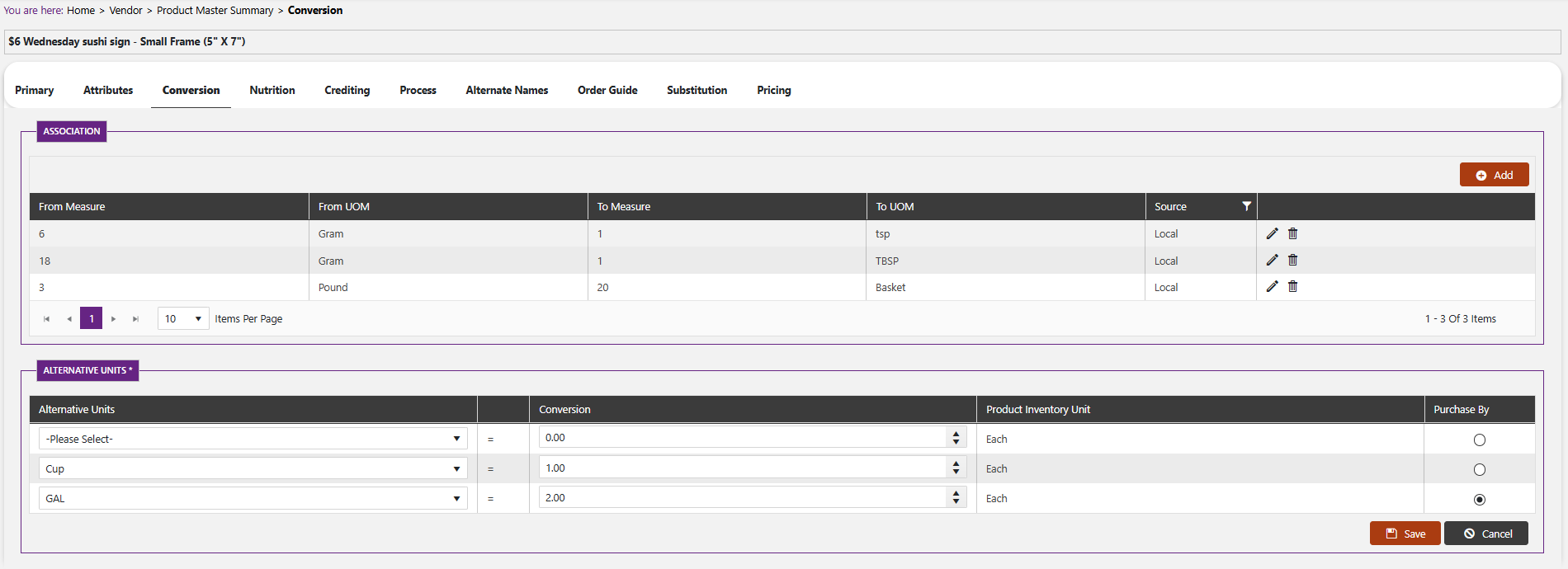
Association Section
Under the Conversion tab, the Association section allows the system to convert complex or custom units into standard weight or volume measurements for this product.
- Click the Add button in the Association section. A new row will be added at the top.
- Fill in the following fields for the new row:
- From Measure: Numeric Stepper — the quantity to convert from.
- From UOM: Dropdown — the unit of measure to convert from.
- To Measure: Numeric Stepper — the quantity to convert to.
- To UOM: Dropdown — the unit of measure to convert to.
- Source: Free text — the source of this conversion data.
Alternative units
It calculates inventory volume based on bulk sizes (e.g., 1 Bag = 7.00 Baskets) and uses the "Purchase By" radio buttons to lock in exactly which unit the system should default to when generating purchase orders.
Nutrition
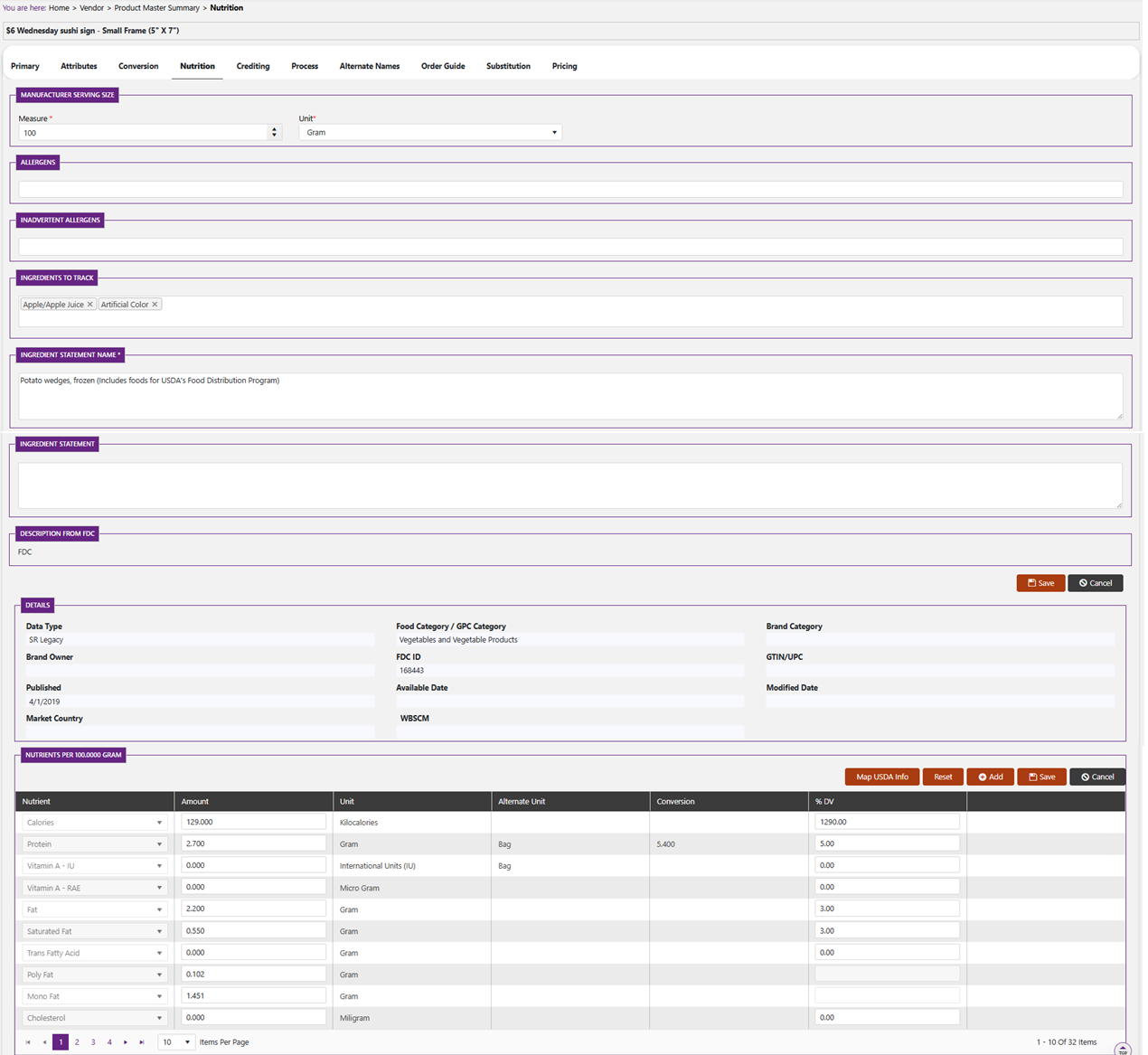
- Measure: Click the box to enter a number for the measure of the manufacturer's serving size.
- Unit: Enter the unit for this product.
- Allergens: Add any possible allergens that people may have to this product.
- Ingredients to Track: Click the box to add any ingredients to track for this product.
- Ingredient Statement Name: Include the product name here.
- Ingredient Statement: Include all of the ingredients here.
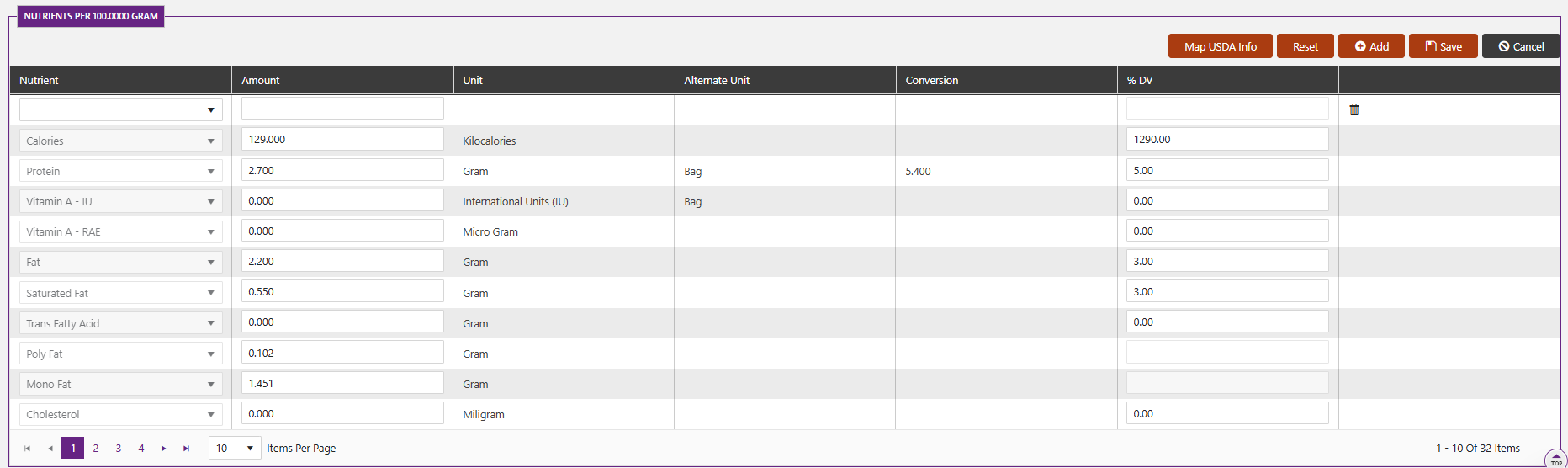
- Nutrients per (Specified Number) Gram: Enter the information about how much of each nutrient is in this product.
- Nutrition: Enter the name of the nutrient as well as the numeric amount of this nutrient is present in this product.
Map USDA Info
Under the Nutrients per 100.0000 Gram section, click Map USDA Info to search for and map USDA nutritional data to this product.
Enter a product name or FDC Id in the USDA Product Search popup and click Search.

Matching results will be listed with USDA Code, Description, WBSM, and Status.
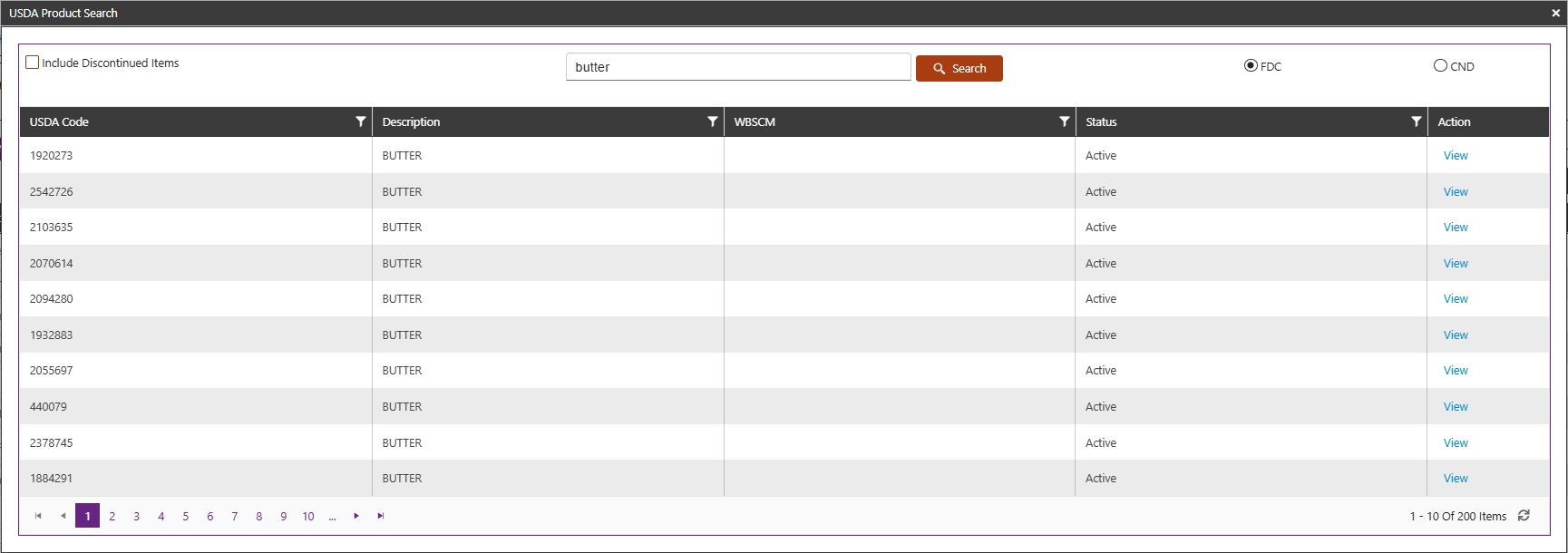
Click the View link under the Action column to see full USDA nutritional details for that product.
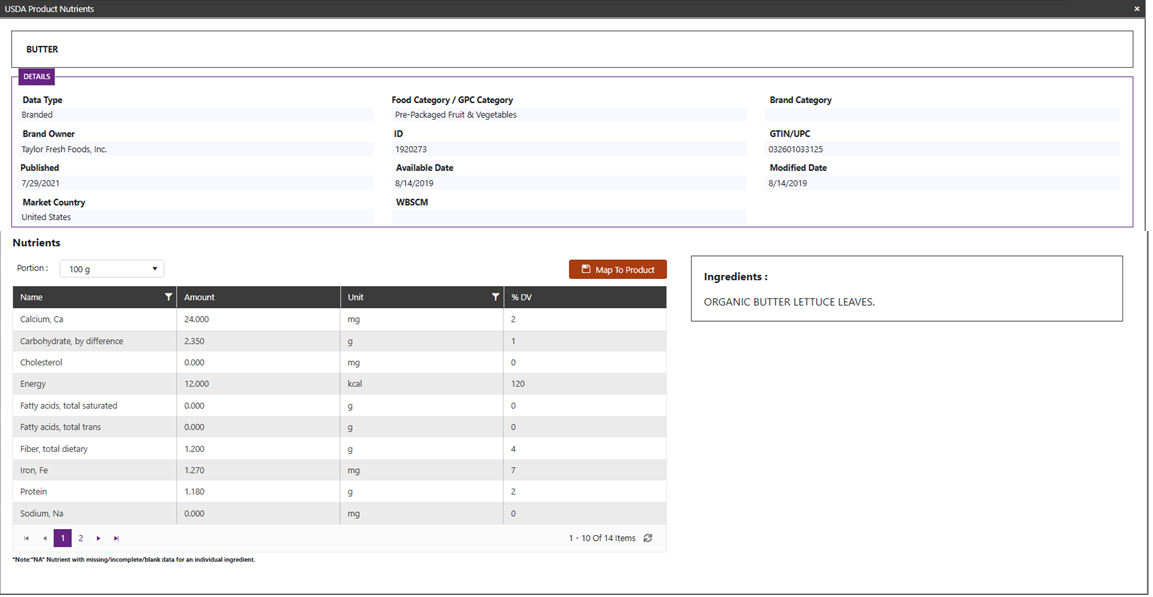
Click Map to Product to link the selected USDA product. A confirmation popup will appear before the mapping is applied.

Reset Button
The Reset button de-links the currently mapped USDA product from this product record.

Add Nutrient Row
Click Add to insert a new row under the Nutrients per 100.0000 Gram section. Select a nutrient from the dropdown, enter the Amount (free text), and enter % DV (free text). Use the Delete icon to remove a nutrient row.

Click Save to save all nutrition data. Click Cancel to discard unsaved changes.
Crediting
Crediting refers to the process of calculating and documenting how much a specific food item or recipe contributes toward federal nutrition guidelines and dietary component requirements, especially those dealing with K-12 schools, childcare, and healthcare.
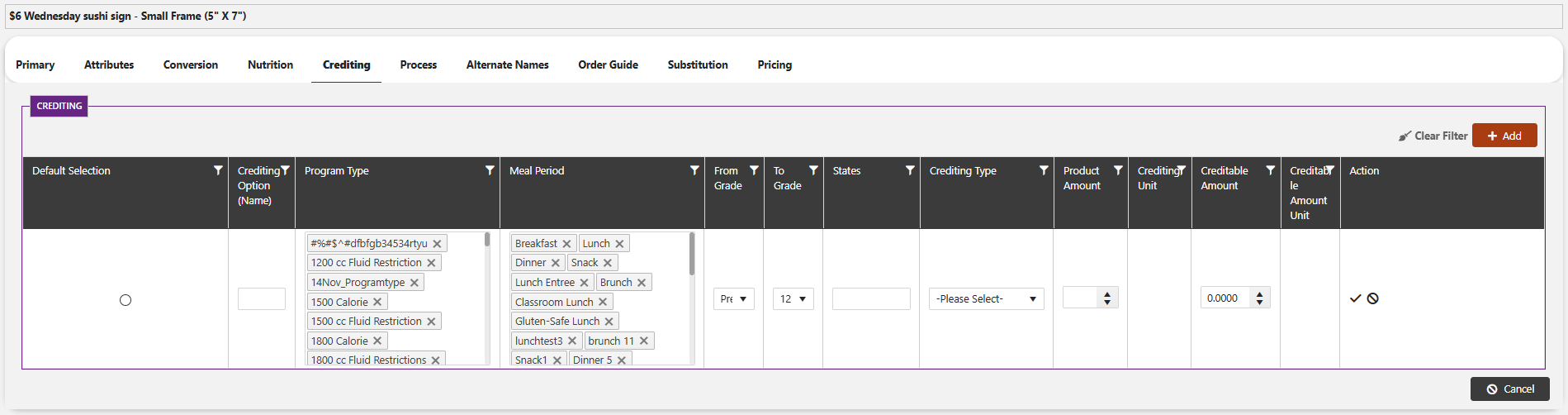
Click the Add button. A new row is added for the crediting entry.
- Crediting Option (Name): Enter the name of the Crediting Option for this product.
- Program Type: Click the dropdown to see a list of Program Types to choose from.
- Meal Period: Click the box to see the available Meal Periods.
- From Grade: Click the dropdown to choose the starting grade this will be available to.
- To Grade: Click the dropdown to choose the grade this will be offered until.
- States: Click the box to add states.
- Crediting Type: Click the box to choose the Crediting Group here.
- Product Amount: Click the box to add an amount of the Product that will be offered.
- Crediting Unit: If this field applies, click the box to choose the unit.
- Creditable Amount: Click the box to enter a number for the Creditable Amount.
- Creditable Amount Unit: Click the box if this information is available to choose the unit.
- Click the check to confirm this information or the red circle with the line through it to cancel this entry.
Process
The Process tab is used to track and calculate food Yield Factors—specifically how a product's volume or weight changes during preparation, cooking, or processing.
In institutional food service, raw ingredients frequently experience weight changes (e.g., meat shrinking when cooked, or dry grains absorbing water). This screen maps those changes to ensure precise inventory, cost tracking, and nutritional scaling.
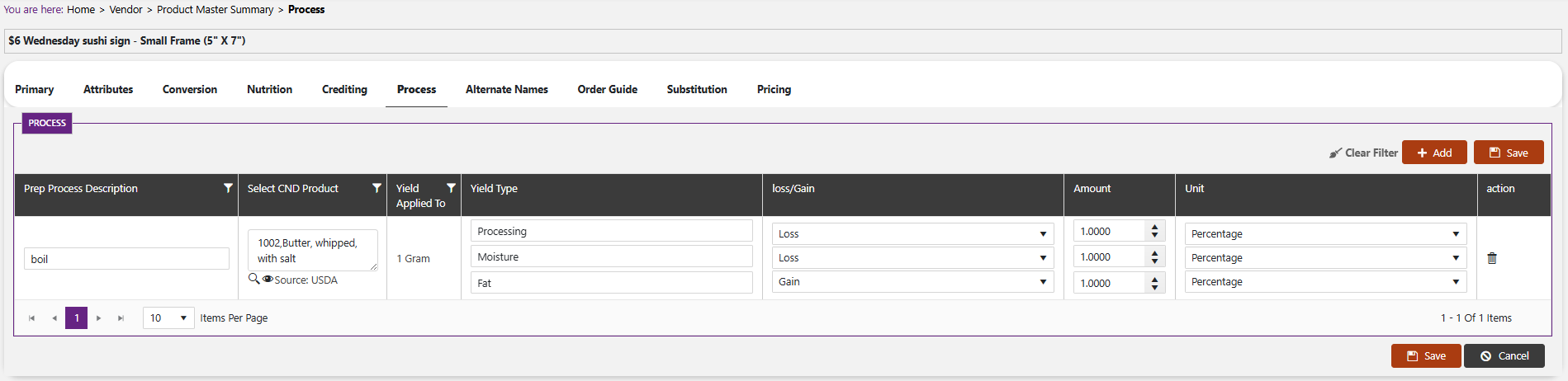
- Click the add button.
- Prep Process Description: Enter the name of the Prep Process for this product.
- Select CND Product: Click the magnifying glass icon to choose the CND for this product according to the USDA.
- Yield Applied To: This is automatically at "1 Each".
- Yield Type: This is automatically generated by the system.
- Loss/Gain: According to the Yield Type, choose whether there is a loss or gain.
- Amount: Choose the amount of the loss or gain of the Yield Type here.
- Unit: Choose the unit of the loss for the yield type here.
Add Process Section
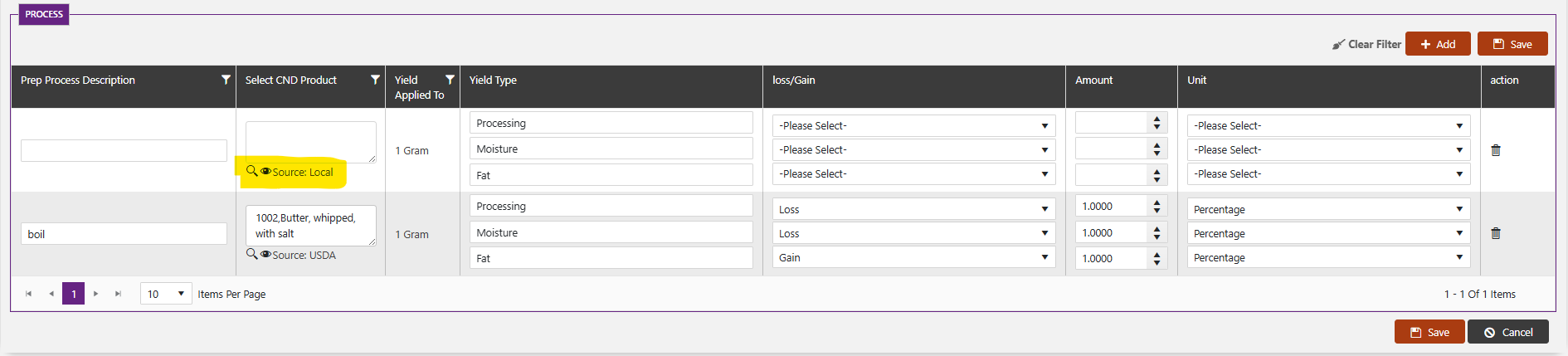
Clicking Add creates a new section under the Process Tab for Processing, Moisture & Fat yield types. You can add the required details and delete any section using the delete icon.
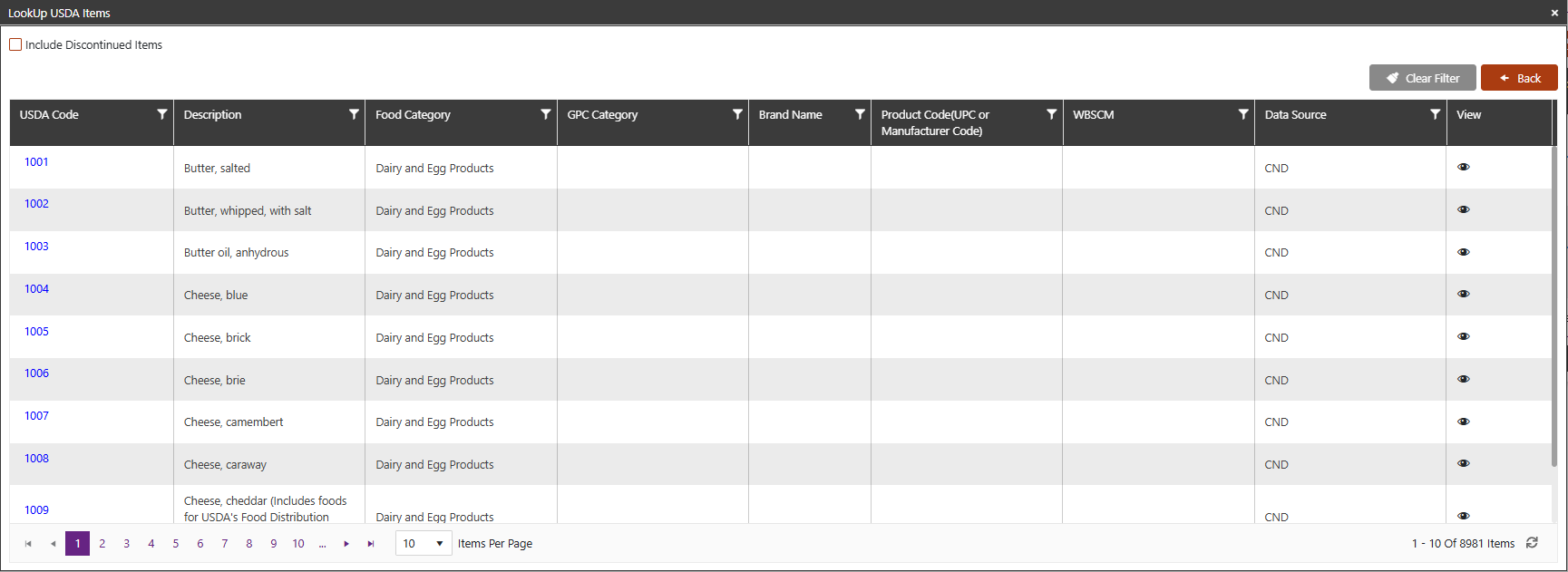
Within each new process section, click the Search icon to open the USDA Item LookUp window.
Click any code under the USDA Code column to select that product. It will appear under the Select CDN Product column in the process section.
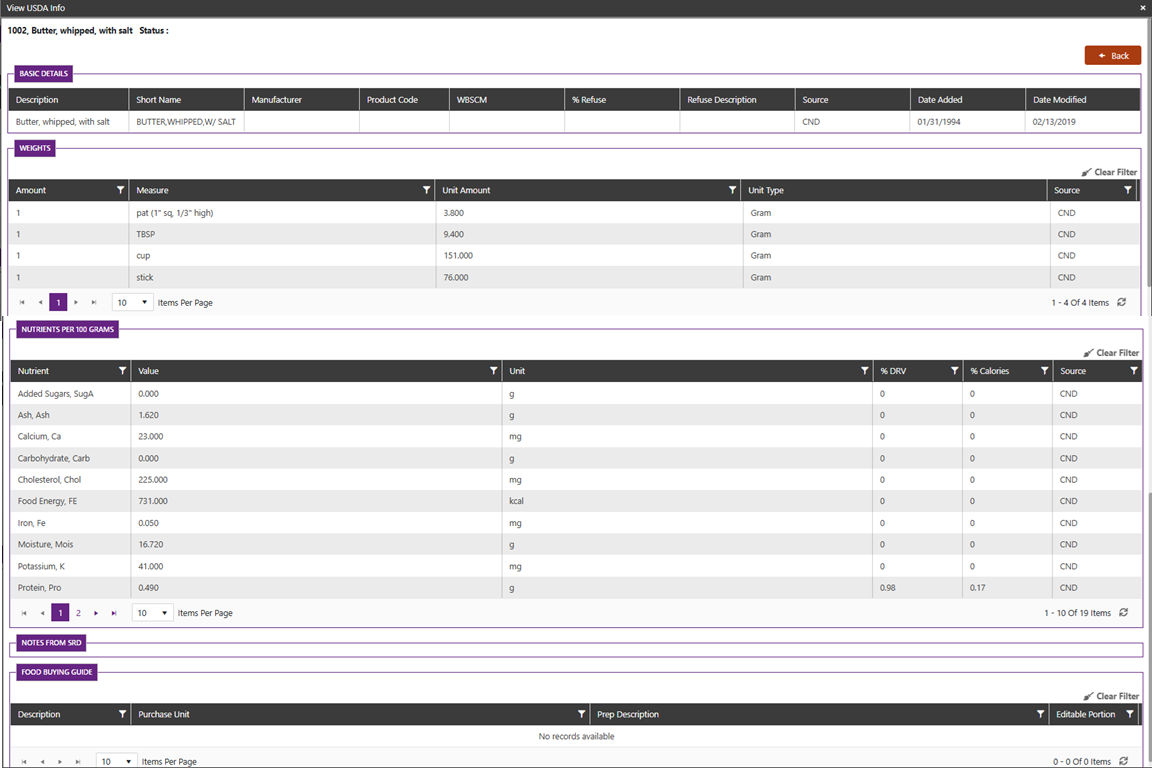
Click the Eye icon under the View column to open the View USDA Info screen (read-only).
Alternate Names
The Alternate Names tab manages how a product is labeled and described across different consumer-facing menus, regional markets, and legal compliance documents.
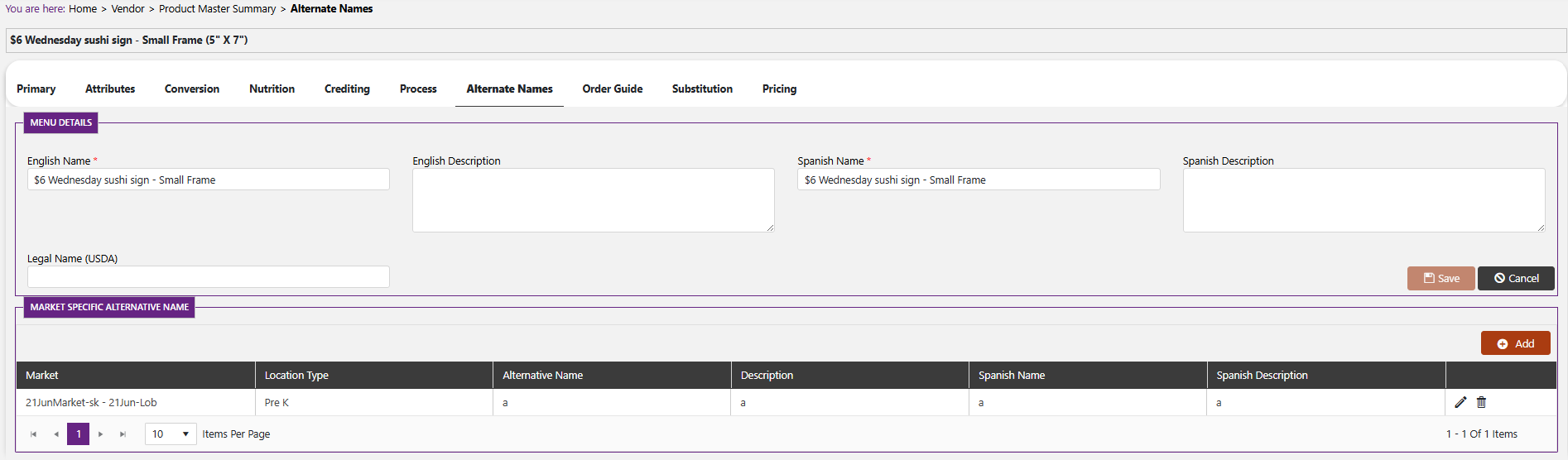
Menu Details: Sets the required English Name and Spanish Name along with customer-facing descriptions for public menus.
- English Name: Include the English name for this product.
- English Description: Include the description of this product in English.
- Spanish Name: Include the Spanish name for this product.
- Spanish Description: Include the description of the product in Spanish.
- Legal Name (USDA): Include the legal name for this product.
- Click the save button to have it show up on the table below.
- Click the add button when scrolling down the page to add another name here.
Market Specific Alternate Names: Allows a single product to carry completely different regional or site-specific names depending on the Market or Location Type (such as customizing an item's description specifically for Elementary Schools versus high schools or community centers).
- Market: Click the dropdown arrow to choose from the Markets available.
- Location Type: Click the dropdown arrow to choose from the Location Types available for this product.
- Alternative Name: Click this to enter any alternative names for this product.
- Description: Enter the description for this product.
- Spanish Name: Include the Spanish name for this product.
- Spanish Description: Include the description of the product in Spanish.
Order Guide
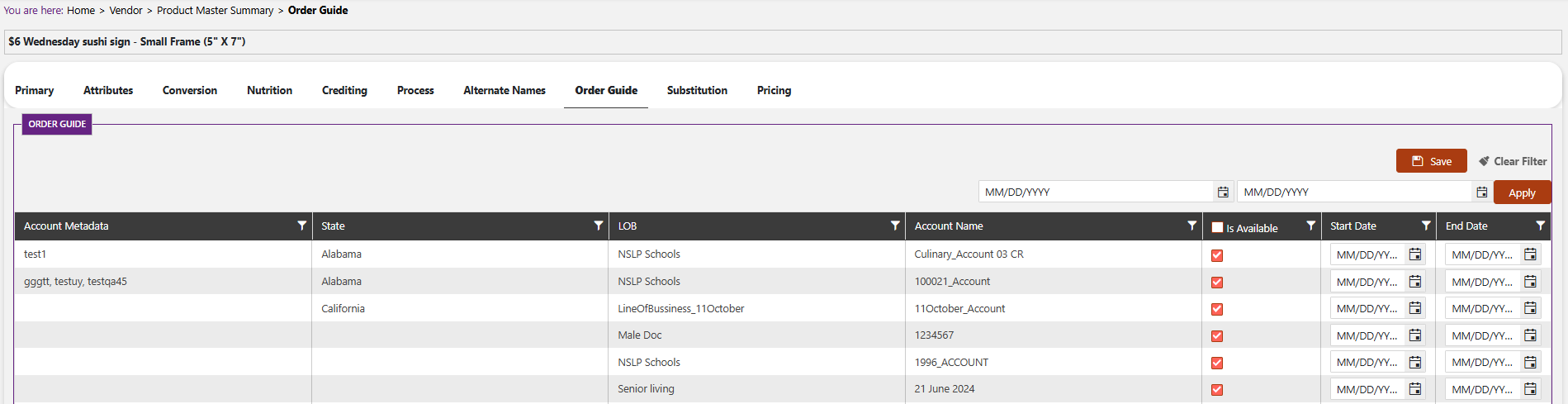
Use this as a way of allowing this product to be available for different accounts. A user can map the respective product to one or more Accounts for a specific date range. Set the Is Available checkbox to control whether the product is available for all locations under the selected account.
Is Available: Checkbox — if checked, the product is available for all locations under the selected account.
Start Date: Date picker — the start of the availability window.
End Date: Date picker — the end of the availability window.
Substitutions
The Substitution tab is used to configure and manage approved alternative products that can seamlessly replace the primary item if it becomes unavailable. In institutional food service, supply chain disruptions, shortages, or delivery failures are common. Setting up predefined substitutes directly in the system prevents operational gridlock when a primary item goes out of stock.
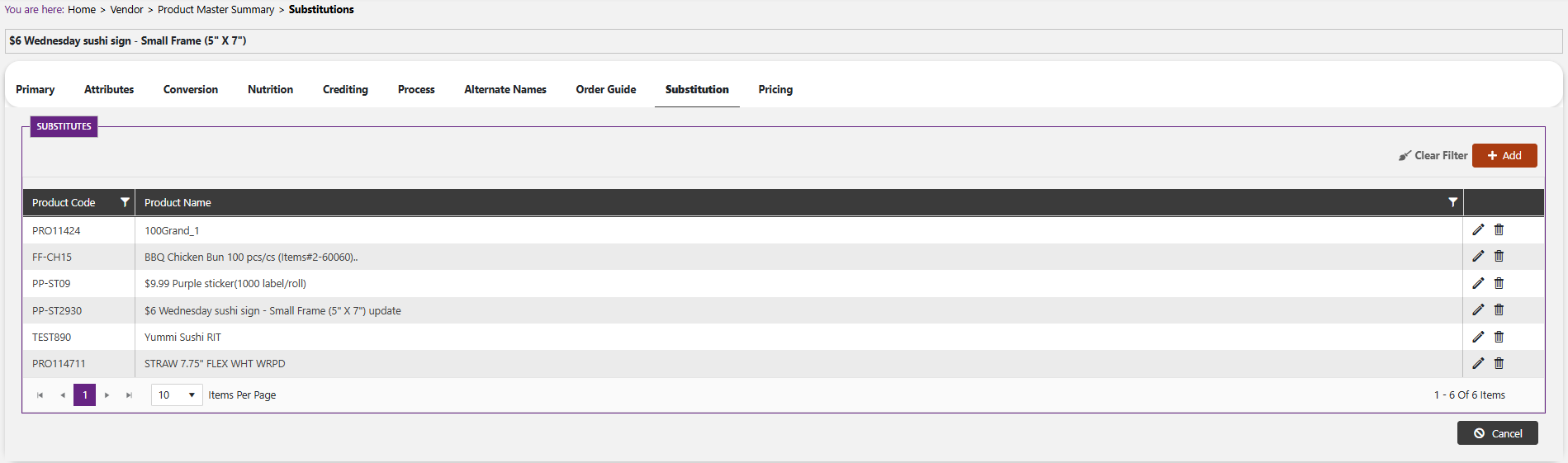
- Click the add button.
- Click the Product Name to see a list of products to choose from. Choose one that would be a substitute for this product from the list.
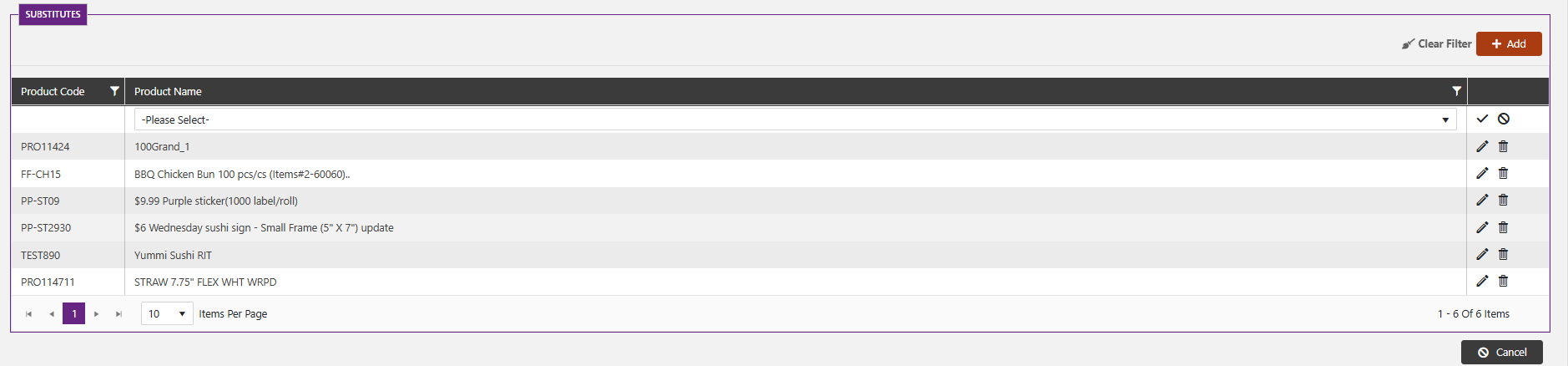
- Click on Checkbox icon to save the record.
Pricing
The Pricing tab manages the financial parameters, vendor contracts, and billing structures associated with a specific product.
Because institutional food service relies heavily on fixed contracts, government commodity values, and fluctuating regional costs, this screen serves as the single source of truth for financial calculations, invoice matching, and meal costing.
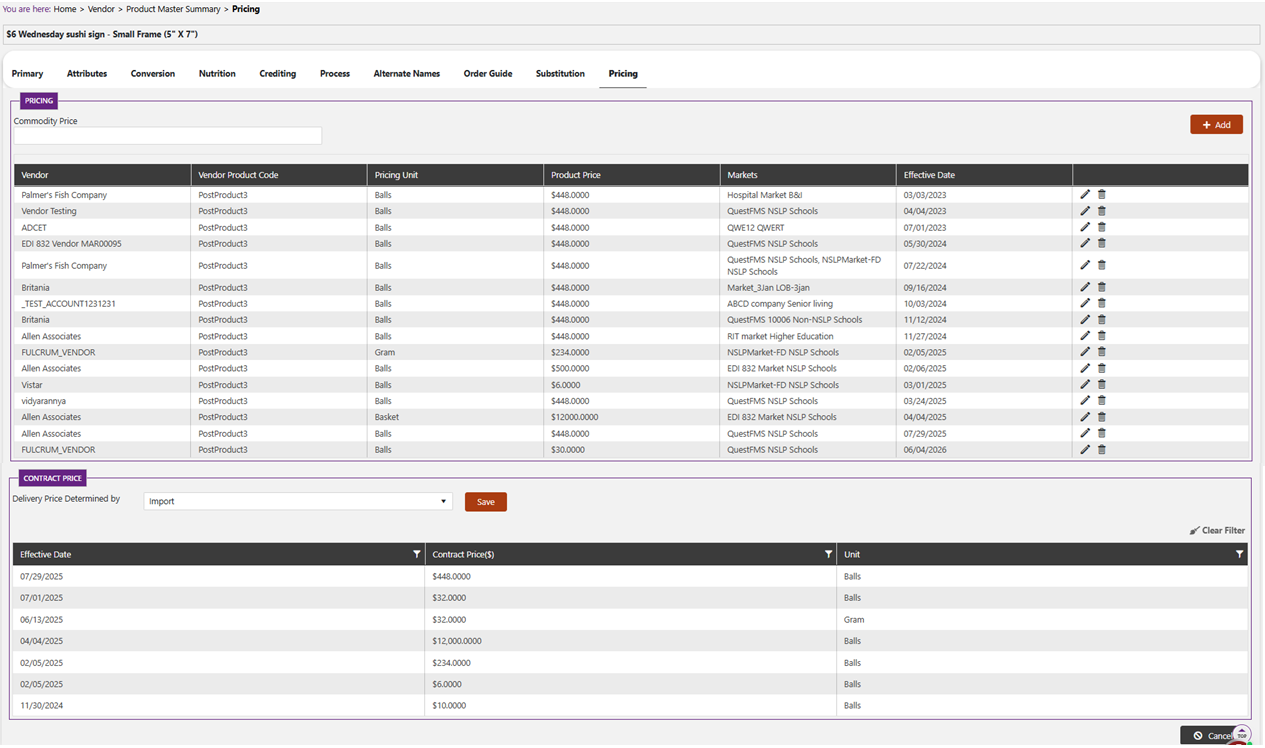
- Click this to see the pricing of the product for your Markets and the effective date of the pricing.
- Click Add to add a new pricing row. Select Vendor (dropdown), Pricing Unit (dropdown), Product Price (numeric), and Market (dropdown).

- Click on Checkbox icon to save the record.